Showing posts with label How To. Show all posts

Thursday, March 27, 2014

How to Paint a Compass Rose

Let's get right to it, and I will take you step-by-step through the process of how I painted the compass rose onto this tabletop.


I came up with the pattern by just fiddling with it.  The center portion of this table is 26 inches in diameter, and the compass rose is 22 inches from point to point.  (not counting the extended part of the outline on the points.) To make the pattern, I taped together some scrap paper, folded it into quarters, and played around with my ruler and a pencil until I liked what I had.  I wanted the sections of the pattern to be long and graceful, without being skinny and hard to paint.  I did a lot of erasing before I came up with the final pattern, which looks like this:


I use graphite transfer paper to get the pattern onto the tabletop.  You can buy it at any craft store.  (The kind that I have is HERE.  I think I got it at Michael's.)  Tape the pattern into position, slide the graphite paper underneath, use the yardstick and a ballpoint pen to trace the pattern onto the table.

Alice and Maggie are helping.


With a pencil, I put a small mark in every other area of the pattern to keep from getting confused as I tape off the pattern.


Speaking of tape, I use plain old Scotch transparent tape when I paint designs onto furniture.  There are all sorts of more expensive options, but I have found that Scotch tape works the best.  I get crisp lines and the tape rarely pulls off any of the base coat of paint when I pull it off.  (For doing this on canvas, I like to use regular masking tape.  Scotch tape and the specialty paint tapes aren't sticky enough for use on canvas.)


Now it's time for LOTS of taping.  Make sure that you accurately follow the margins of the areas that will be one of your colors.  (I painted the marked areas first.) 


Some of the ends of your pieces of tape will overlap into areas that you want to paint.  No worry ... use a craft knife to carefully cut and remove the tape in these spots.


First color ... Scandinavian Pink.  Two light coats.


When the paint is dry to the touch, carefully peel the tape.


I see a little piece of tape that I missed when I was trimming the overlapped parts.  No worry, just touch it up once the tape is removed.


When the first color is completely dry (you can speed up the process with a hair dryer), tape and paint the second color ... in this case, it's Chateau Grey.


Wasn't that easy?


To finish this off, I handpainted the grey outline using ASCP Graphite.  I put some paint into a paper cup, adding a little bit of water so the paint would flow better for a smooth outline.  This part of the process was tedious and stressful.  There's no easy way to hurry it ... I just had to sit there and carefully paint fine lines.  At least I had company while I was working.

Dorothy was trying to get my attention by being completely adorable.


I painted an outline around each section of the compass, and between the Country Grey background and the Old Violet edge of the tabletop.  It took about a half an hour to do this.


Didn't I tell you that it was easy?  So easy that I was crazy enough to do two of them at the same time.


The only part of the process that required any skill or ability was the outline.  Take your time, practice on scraps if you have to.  You can do it!

Next post ... revealing the finished tables.  Tomorrow, I hope.

Tuesday, February 7, 2012

Waxing the Big Blue Dresser

Thank you for all of the lovely comments all of you left on yesterday's post about the Big Blue Dresser.  I am humbled by your kindness.

As promised, here are some tips for you ... illustrated with photos of the steps that went into waxing Big Blue.  My goal with this piece was to produce a finish that looked like a genuine, aged old paint patina.  Annie Sloan Chalk Paint, in 'Aubusson Blue' in this case, along with clear and dark wax, are the perfect materials for doing this.

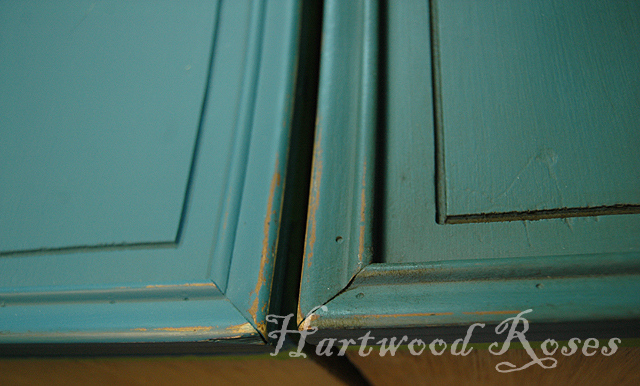
Here are close-ups of two drawers ... the one on the left is painted and distressed, with no wax yet.  On the left is a finished drawer.  See how the dark wax brings out the details?


Annie Sloan stockists sell beautiful wax brushes ... but I don't have any of them ... yet.  I use a natural bristle chip brush to apply my waxes.


The goal is to apply as little wax as possible, and to rub it INTO the paint ... not have it laying on top.  (You can tell you're using too much wax if it makes gummy boogers while you're rubbing it in.)  I dip the brush into the clear wax, picking up a LITTLE bit of wax, and I rub the brush in circles on the paint until the surface looks evenly 'greasy'.  The photo below shows an area that needs more rubbing ... not necessarily more wax.


The area on the left side of this drawer below is what it looks like when the wax is adequately rubbed into the paint.


I then rub off as much wax as I can with a clean cloth.


At this point, before the clear wax has a chance to set up, I begin to apply the dark wax.  A little dab goes a LONG way.  With the drawers on Big Blue, I started by using a brush to rub a light coating of dark wax into the groove on the panel of the drawer front.  (remember ... one brush for clear wax, another brush for dark)


I used a cloth to quickly spread the wax into the corners and wipe off any excess.


When the groove and edges of the panel were to my liking, I turned my attention to the center.  Working quickly, I used my brush to spread a small amount of wax evenly on the drawer.


I immediately grab my cloth and spread the dark wax onto the drawer in a circular motion, finishing with long horizontal strokes to wipe off excess wax ... until I got just the result I was looking for.


The beauty of this process is that it is almost completely adjustable.  You can wax as dark or as light as you want ... and you can remove some of the dark wax with clear wax if you need to start over.

This is what the center of the drawer looked like when I finished it.  See the difference between the waxed center of the drawer and the still-to-do molding on the edge?  I love how rich 'Aubusson Blue' looks with a good coat of dark wax!


Sometimes I want to accentuate a corner or contour, so I put a dab of wax on my cloth and carefully work it in with light strokes.

Once the wax is dry (I usually leave it overnight), use a clean cloth and buff the surface till you get a nice even shine.


Here's one of my best tips ... Don't be tempted, especially on a large piece like Big Blue, to wax the whole piece with clear wax THEN go back to apply the dark.  Do one small area at a time, like one drawer or one side of the piece, and you will have more control. 


I cannot overstate how much I love the look and feel of a hand-rubbed wax finish on painted furniture!  I am an extremely tactile person, and the silky surfaces are REALLY nice.  (My #1 rule:  If a piece is not silky and smooth, it doesn't leave my workshop ... period.) 

I hope this demonstration will help you achieve a beautiful wax finish on YOUR projects.  Let me know if you have any questions.


Saturday, January 1, 2011

How to Prune and Train Ramblers ... starring Albertine

When I tell folks that rambler roses can grow to be more than 20 feet across by the end of their third year, I usually see a look of fear spread across their faces.  With this post, I hope to show you that these roses are well within the reach of most gardeners ... and are a beautiful asset to the garden.

This is 'Albertine', a Hybrid Wichurana rambler introduced in France by Barbier & Company in 1921.  She will be our demonstration rose for this lesson.


Ramblers are once-blooming roses, which bloom profusely in the late spring on canes produced during the previous year.  New canes, which are long and flexible, grow from the base of the rose each year (called 'basal canes').  If left unpruned, a Rambler will grow into a large mound and spread across the ground.  Pruning them is very straight-forward, and can be accomplished on a large rose in about an hour. 

I find it best to do this in winter, when the canes are leafless and it's easy to see what I'm doing.  It feels good to get outside on a mild winter day and accomplish something in the garden.  (Temperatures here in Virginia have been in the upper 50's for the past two days ... perfect pruning weather!)


The older canes on 'Albertine' are those that are already attached to the fence.  The new canes produced during the growing season are the ones arching away from the fence.


The goal is to prune out old, excess canes and spindly, unproductive growth, keeping ten or twelve canes, and attaching them to the fence in a fan-shaped pattern. 


My ramblers each grow with a clematis in them, so I have the quick extra step of cutting off and removing the tangled, dead clematis stems.


This is what 'Albertine' looks like from the back of the fence.  Throughout the season, she sends shoots through the fence, seemingly heading for the neighbor's house.  Most of this growth will be removed.  Sometimes I will retain a particularly nice cane from the back of the fence, if I can maneuver it through the fence to the front side.


It is important to remove any canes that are dead or broken.


I cut out old, woody, unproductive canes, stepping back from time to time to get a good overview of my progress.  While I'm working, I keep my goal in mind ... retaining the long younger, flexible canes that will flower best in the spring. 

Don't be afraid to cut!  'Albertine' lost about half of herself while I was sorting canes and cutting.  Alberic Barbier, another rambler I pruned today, lost at least 3/4 of his canes.  He was REALLY overgrown, because I hadn't pruned him at all last year, and I only pruned lightly the year before. 

When in doubt, cut it out, is my motto.  If you cut a cane that you regret, arrange those that remain and you can cover up your mistake.  Ramblers are vigorous growers, and they recover quickly from hard pruning.

The old canes are gone, leaving the flexible new canes in the front.


The back of the fence is all tidy ...


... and the canes that remain are ready to be arranged and attached to the fence.


At this stage, I look at what I have left to see which canes will naturally go right or left, high or low.


I fine-tune my selections, and I sometimes discover that a cane is too stiff or pointing the wrong direction to go where I want it to go.  The cane marked below is healthy and I would love to have kept it, but there was no way I could have bent it enough to attach it to the fence without breaking it.


One by one, I attach the canes to the fence in a fan shape, as horizontally as I can get them without bending or breaking them. 


When rose canes are trained to at least a 45 degree angle, they produce more flowering laterals, which means that you will get more flowers. (Canes that are trained vertically will only bloom on the ends.)  The photo below shows one cane last spring, with its flowering laterals.  Look how many buds there are!


When we planted these roses, we stapled a single strand of fence wire between the boards of our fence to make it easier to attach the roses to the fence.  That's why it looks like the canes are floating between the fence boards.


Want to see the result?  I left 'Albertine' with ten healthy, flexible canes (five per side), attached to the wire.


Here is the pay off ... a well-tended rambler that produces maximum flowers on a healthy plant ... and, the way I do it, it only takes an hour or so per year to achieve.  (I'm using Leontine Gervais for this example, since these are such a good photos to show how many flowers ramblers produce.)


I make no secret of the fact that Ramblers are one of my favorite classes of roses.  Their flowers are beautiful and fragrant, their leaves are resistant to disease, they grow despite drought and neglect, and they are a powerful presence in the garden.

This is the upper part of the Rambler Fence in 2009.  The roses, left to right, are Alberic Barbier, Paul Transon, and Aviateur Bleriot. 


If you have any questions about Ramblers (or anything about roses, for that matter), send me an email or leave a comment.


'Albertine' wants to thank you for coming, and she hopes you will consider adding a Rambler or two to your garden
Related Posts with Thumbnails