Wednesday, July 15, 2009

One Little Found Rose.

I have this cute little polyantha rose that I call Sumerduck Cemetery … because I found it beside a grave in a cemetery in Sumerduck, Virginia.

Sumerduck Cemetery Polyantha


The bush was a little more than 2 feet tall, sticking out the top of a struggling clump of hosta. I took a small cutting that day, and I was able to root two plants from it. I also trimmed some of the dead wood off the mother plant … I believe we should leave roses in better condition that they were when we found them.

As I was coming home from Culpeper yesterday afternoon, I stopped at the cemetery to check on the little rose. Here’s what I found:

Embrey Grave w/o Sumerduck Polyantha


The rose is completely gone. I dug through the heap of hosta, hoping to find something underneath … there’s no sign of it. I don’t know if it was a victim of our extreme drought last summer, or if it died because of the unseasonable cold last winter, or if someone was tidying up and removed it.

Things like this happen all the time. There are roses in a cemeteries/old house sites/vacant lots that die from weather, are weed-wacked, sprayed with herbicide, cut down, dug out, bull-dozed, etc. I hope there are other people who feel the loss of the heritage that this rose represented.

I’m glad I took a cutting that day I found it. This rose, whatever its identity, will live on in my garden … and your garden, too, if you choose to buy it while you’re here.

Saturday, July 11, 2009

Roadside Rose Rustle

My husband and I were driving through Virginia’s Northern Neck yesterday evening. “There’s a rose,” I said, as we passed some sort of utility building. He turned around so I could check out my discovery.

Swamp Rose

It was Rosa palustris, the Swamp Rose, growing happily in the ditch next to the building’s driveway. I don’t grow this one yet, and I wanted to take cuttings … but we were in his truck, and my cutting kit is in my Jeep.

We searched the truck and we found what we needed: pruners and a left-over bottle of water in the console, leather gloves in the bag with the bungies and tie-downs, and napkins and a zip-lock bag in the glovebox. I had to borrow my husband’s shoes because I was wearing flip flops … not exactly the footwear of choice for walking through a thorny ditch.

Swamp Rose

I tip-toed along the ditch and took a handful of cuttings. I laid my cuttings out on the tailgate of the truck, wrapped them in napkins, put them in the zip-lock bag, and poured in some water. They’re in the basement refrigerator right now … I’ll put them in the greenhouse later today.

Monday, July 6, 2009

Baby Pictures

Yesterday, I looked up from my daily routine of caring for all the pots of roses for sale and I noticed how well they are doing. In just the last month, most of them have more than doubled in size. Quite a few of them are already on their second cycle of bloom. It’s amazing what these little babies are capable of.


Caldwell Pink

Here is a slideshow of photos taken yesterday morning. All of these photos are of roses in pots in the nursery area, ready to go to their new homes.


Slide Show


Enjoy!

Saturday, June 27, 2009

Propagation!

I used this set-up to propagate the roses we have for sale this year.

Mist Rack


It holds 12 flats under a mist line, and it was easy to find a sheltered spot for it outside. This year, I have to propagate at least twice as many roses as I did last year, so this even close to large enough to do the job.

After a bit of brainstorming, I came up with this:

Propagation Bench


20 concrete blocks for the legs (free, via an ad on Craigslist), 4 sturdy shipping pallets for the top (Craigslist, again), hoops of flexible PVC pipe, held in place with screw-in pipe clamps, ½” electrical conduit to hold the mist line, a handful of cable ties … and we now have a propagation bench that can hold WAY more than last year … maximum capacity is 36 flats with 36 pots in each flat ... which equals a whole lot of cuttings! And it was almost free, which is the best price I know.

I have already been taking cuttings of everyone’s Wish List roses. Look on the web site for the list of roses in the garden to see what we grow here. There just might be one that you’re dying to have … let me know what it is, and I’ll add it to my propagation list. Leave me a message here, or send an email via the web site.

Thursday, June 25, 2009

The Soon-To-Be Nursery Office.

The little cinderblock building beside the barn is the perfect location for the nursery’s office. It’s 10 feet by 20 feet, divided down the middle into two rooms, with a perfect southern exposure. With a bit of work, and some imagination, it’s going to be incredibly cute.

Here it is before we did anything to it:
Photobucket

This is what it looks like now, with its new roof:
Tack Shed New Roof
(Isn’t the barn fantastic now?)

It’s going to be painted these colors:
Cottage Colors


The yellow is for the body of the building. The trim on the eaves, the doors, and the windows will be white. The windows themselves will be blue, and the door will be purple. These colors look really, really good next to the red barn.

I'm replacing original broken, rotten windows with some of my old, scrounged windows. These two-pane ones fit the openings perfectly, and they add to the cottage-ey feeling that I’m going for. They need a bit of work, though.

Before:
Windows, Before

During:
Window, During

After!
Window, After

(only 4 more to go)

The original door was built from two layers of tongue-and-groove pine. The frame was rotten, the door itself had seen WAY too much target practice from previous owners, and I’m going to buy a new one. I found the one I want at Lowes … ¾ glass, with two raised panels at the bottom. A lot like this one:

Tack Shed Door

(Now picture it painted purple.)

We have been calling this building the Tack Shed, because that’s what the previous owners called it. I see it as a cottage, and I’ve been trying to think of a better name for it … “The ??? Cottage”… I haven’t come up with a name that I like yet. Any ideas?

The Coolest Tool for Tying Climbing Roses.

We have LOTS of climbing and rambling roses here. Tying these roses to the fences and arches and pillars could be a full-time job if I did it with twine.

I was talking to my neighbor next door at the winery last summer, and he showed me the tool that they use to trellis their grape vines in the vineyard. It’s called a Max Tapener, and it’s the slickest thing I’ve just about ever seen. With it, I can attach a rose cane to its support using one hand!

Tapener

Our rose fences all have strands of wire on them to use for attaching the roses.
Wire on Post


All it takes are three simple steps:

Click the tool to draw up the tape.
Photobucket

Stretch it across the rose cane and wire (or trellis bar, or arch).
Step 2

Close it like a stapler. The tool staples the tape and cuts it off. Step 3


Cool, huh?

Wednesday, June 24, 2009

To Spray or Not To Spray …

I spray my roses. When I tell people this, I imagine that they are picturing me out in the garden wearing a haz-mat suit, carrying a pump sprayer with a skull and crossbones on the side of it. There are rose gardeners who want to kill every bug and fungus in their garden … but that’s not me. I just want my roses to have leaves in the summer.

Blackspot, and other fungal diseases, are a huge problem here. Without fungicide, my roses will lose their leaves. The rose would then have to expend its energy reserve to replace those leaves. Without leaves, the rose loses its ability to produce carbohydrates for growth and flowering. I want my roses to grow and flower, not sit there and struggle to grow leaves.

I use Bayer Advanced Disease Control fungicide. NOT the Bayer product with insecticide and fertilizer, and NOT the one you mix and pour on the soil. The concentrate in the blue bottle … for some reason, it’s only available at Lowes and some specialty nurseries. It’s good stuff, reasonably priced (around $15.00), and it’s worth the effort to find it.

Fungicide

Spray Day this year has been every other Thursday. It takes me about 2 ½ hours. My sprayer is a 2-gallon pump sprayer.
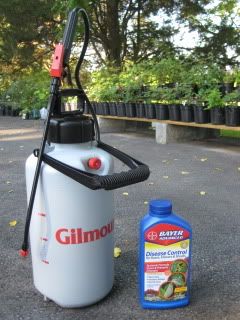
Large Sprayer and Fungicide

With 600+ garden roses here to care for, and the 400-or-so Inventory Roses, I have to fill the sprayer 5 or 6 times. With a garden this spread out, going back and forth to the faucet to refill the sprayer gets pretty tiresome. I will soon be on the hunt for a new sprayer with a larger capacity … probably an electric one on wheels that I can pull around.

What should you do if you have only a few roses to spray? How about a little half-gallon sprayer like this:
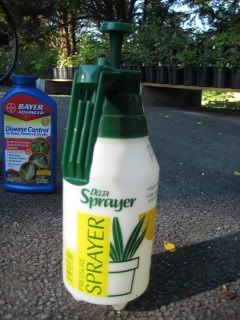
Small Sprayer


It's available in the garden department of just about any big box store, and it only costs a few dollars.

I’m a big fan of the concept of Integrated Pest Management (IPM). This is a fancy way of saying that I only treat the pests and problems that are beyond my tolerance. Aphids? I let the birds and good bugs get them. Japanese Beetles? Sometimes I knock them into a bucket of soapy water. Sometimes I see how far I can flick them. I taught my grandson to flick them ... sometimes we have contests to see who can flick one the farthest. Mostly, I just ignore them. Thrips? These have been terrible this year, and they are destroying a majority of my buds, so I may have to resort to something to salvage any flowers at all. So far, I have just ignored the thrips, too.

The most important part of pest control is to identify the pest you are trying to control, whether it’s a fungus or an insect pest. Don’t ever throw pesticides at an unknown problem hoping to eliminate it. It’s bad for the rose, it’s bad for you, and it’s bad for the environment.
Related Posts with Thumbnails