Showing posts with label Propagation. Show all posts

Thursday, November 17, 2016

As Gardening Season Winds Down

Fall is officially here, and winter will soon bring freezing temps and an end to outdoor gardening.  What's a rose gardener to do?  Bring the garden indoors, of course.  

In my last post (which was WAY too long ago) I showed you how I brought a bit of light and cheer into my greenhouse.  Next thing on my list was to finish preparing the area where the baby roses will spend the winter.


Instead of heating the whole building to keep the little pots from freezing, using a TON of propane in the process, I'm going to use a propagation heat mat underneath the pots.  I put two layers of insulation on the bench (one piece of solid foam and a layer foil bubble insulation, topped with the heat mat.


The mat is connected to a thermostat with a probe, to monitor and control the temperature of the pots.  So far, it's working really well.

The read-out on the thermostat shows the temperature of the pot that contains the probe.


The sun warms the greenhouse during the day, and the mat should only be needed during really cold nights.


In the house, things are going gang-busters in the propagation area in my basement workshop.  


I planted these cuttings at various times in October, and some of them are already showing awesome roots!  (I attribute this to some good luck, careful attention, and a little bit of help from bottom heat provided by the fluorescent light on the shelf below the cuttings.)   Roots usually show in four to eight weeks.  It looks like these little baby cuttings are VERY anxious to grow up and become real plants.  

Allow me introduce you to ...

"Haywood Hall"  A Noisette rose that was found at Haywood Hall in Raleigh, North Carolina.  It is one of the best Noisettes in my garden and very few people know about it.  Because of this, I want to share it around to make sure that it doesn't disappear.

Spray of "Haywood Hall" in my garden last month.


Tag, showing the date that I planted the cuttings.


Growing roots like this after only three weeks!


'Pink Poodle' (a miniature rose from 1991) is very rare and, again, needs to be propagated and spread around to insure its survival.

'Pink Poodle' showing some deeper-than-normal color in cooler autumn weather.


Cuttings didn't even drop one leaf.


Visible roots in three weeks!


"Talcott White Noisette" grows in Hollywood Cemetery.  It is a very old, very large plant, in an out-of-the-way location.  As far as I know, no one has ever propagated it.  


Visible roots in four weeks!


While I was in Harrisonburg, Virginia, last month, I visited Woodbine Cemetery.  I always have my tools with me, and I took a few cuttings of the roses that I saw there.  One of them was an incredibly fragrant Noisette-type rose.

The flowers on the cuttings perfumed my whole car.


The plant at the cemetery is 7-8 feet tall.


Visible roots in three weeks!


While the outdoor garden is slowing down, you can see that things are just getting started indoors.  Soon, the basement rose babies will be potted up, and they will join their buddies to spend the winter in the greenhouse ... gonna have to tidy up some more to make space on the bench for them.

*************************
To learn the method that I use to root roses, click HERE.

Thursday, June 9, 2016

Josiah Ryland's Rose

There is a small rose growing in the shade beside an ornate iron fence in Section B at Hollywood Cemetery.  I have visited it many times, but I have never seen a flower on it ... till last month.


This flower is not much to look at, definitely past peak and a bit tattered, but it's a beautiful flower to me.  


Timing was perfect and the plant was in good enough condition to allow me to carefully snip five cuttings ... to try to propagate it, preserve it, and possibly determine which rose it is.


I checked on the cuttings this morning and I saw a root!!


More roots!!


Whatever this rose is, it rooted VERY quickly.  All five cuttings are in this container, planted on May 19, and multiple roots are visible on the side and bottom of the container three weeks later, today, June 9.  (Six to eight weeks, maybe longer, is more typical.)

These roots hold the promise of plants that represent the opportunity for me to grow Josiah Ryland's rose under more favorable conditions than it has at the cemetery, to share it with others, and (fingers crossed) to figure out which rose this is.

*************************
Click HERE to go to my Rose Rooting Tutorial, and see how simple it is to root roses and other plants for yourself and to share with friends.


Monday, February 29, 2016

Baby Roses in the Basement

One corner of my basement workshop is set up as a place to nurture my fall rose cuttings and to hold over any resulting plants till it's safe for them to live outside in the spring.  It feels wonderful to work with green, growing things in winter, while the world outside is brown and dormant.  It's the main way that this gardener survives the downtime of winter.


My light set-up is simple ... a chrome-plated shelf rack from Costco, and each shelf is fitted with a cheap four-foot two-bulb fluorescent light fixture.  One bulb is cool spectrum, one bulb is warm spectrum.  This is not as efficient as the expensive grow lights, but it does the job that I need.


This year's crop of roses is very special to me.  They are some of the rare ones from my garden, along with plants from the collection at Monticello's Tufton Farm.  A few of these babies are destined to be traded with rose friends.  Most of them will be sent to rose nurseries, for use as stock plants ... with the goal of making them available in commerce in the future.  This is the best way I know to preserve these roses, and to do what I can to insure their continued survival.


In addition to the roses, I also have some baby fig plants.  These came from cuttings that I took last October at an abandoned service station in Louisa County, Virginia.  (I love figs almost as much as I love roses.)

There's a Magnolia seedling in there, too, that I found growing underneath one of my roses last fall.


In the next week or so, I will package up the Florida-bound plants and ship them to their new home at Rose Petals Nursery.  The rest of them will stay safely in the basement till the end of March.  That's when I plan to transplant them into six-inch pots and begin to transition them to their life outdoors in the garden.

"Preserving history one rose at a time" 

(This is the motto at Rose Petals, and it perfectly expresses exactly how I feel about what I do!)

Click HERE to go to my propagation photo tutorial.  It's really, really easy!

Sunday, June 14, 2015

Sunday Snapshot ... Propagation Time!

Now that the roses in my garden are past peak bloom, it is time for me to take cuttings for propagation.  When I was running the nursery, I felt the need to cater to the market and propagate the roses that customers expected to find in stock.  These were mostly old garden roses that are fairly common, ones that most rose-growing folks had heard of.  I was never comfortable with this.  The few rare and unusual roses that I rooted for sale tended to be ignored, while the familiar ones sold without much effort.


Yesterday morning's harvest of cuttings.


Now that I don't have to supply a nursery inventory anymore, I can propagate what I think is important ... roses from here and other places that are the rarest and most vital to multiply and distribute, roses that I have agreed to trade with friends, and, beginning this year, roses from the Rose Field ... the next step in my current plan to reclaim that heinous mess of a former garden.


The cuttings are now safely sitting in the north-facing window in my cool basement, where I can easily keep an eye on them.


You're probably wondering ... what roses were in this first batch of cuttings?  They are:


"Tidewater Trail" is a Hybrid China rose that I found in 2009, growing beside the fallen porch of a derelict house south of Fredericksburg, Virginia.


"Dennis's not-Anemone Rambler" is a wonderful unidentified Hybrid Setigera rose.  Dennis received it as a small plant, with a tag in the pot that said 'Anemone' ... which it obviously is not.  He shared his plant with me.


I have shown you this rose many times, "Pink Van Fleet", which is possibly the real 'Bess Lovett', that appears to be lost in the US.


'White Cap' is the best performing climber that I grow.  Most people don't know about it, though, and it is very hard to find.


"Faded Pink Monthly", a rose found by Mrs. Keays, is the first Rose Field rose that I took cuttings from.


If you want to learn how to root your own roses, THIS LINK will take you to my photo tutorial that teaches you the method that I use.

Happy Sunday, Everyone ... I'm heading outside now, to go take more rose cuttings.

********************
Sunday Snapshots are posts that are devoted to a moment in time that represents a slice of life in Hartwood, or wherever else I happen to be at the time.

Tuesday, March 31, 2015

Blooming in the Basement ... Single Pink China

The cuttings that I took at Monticello's Tufton Farm last October are growing like crazy under their lights on the shelves in my basement workshop.  A few of the cuttings have buds, which I will leave in place so I can confirm that each plant still has its correct identity on the label.  More important than this is the joy that I get from seeing these tiny plants (ones that I started from a stick and a prayer) grow and push out buds and flowers.


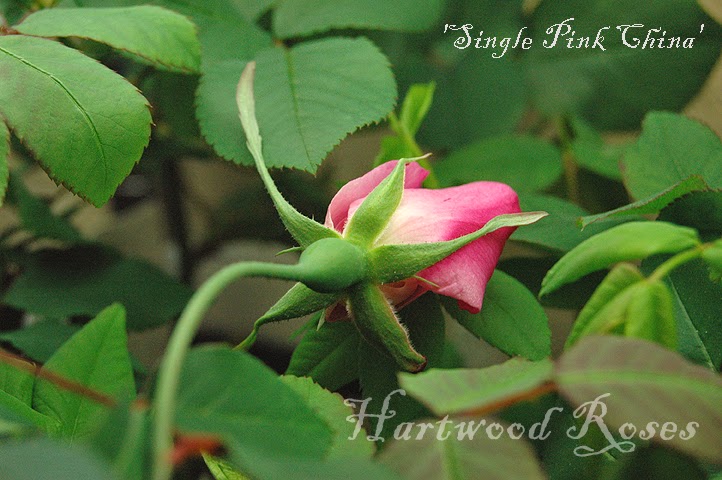
The flower that opened this morning is on a plant of 'Single Pink China'.  'Single Pink China' is a very rare rose, thought to be a sport of 'Old Blush'.  The plants themselves are very much alike in the garden ... but 'Old Blush' has semi-double flowers and flowers on 'Single Pink China' have a single row of five petals.  As far as I know, there is no nursery in the US that sells this rose.


Five delicate petals on this flower, with a couple of quirky petaloids that many single-flowered roses have.  I could have groomed those out, but I didn't


It's still too early for me to begin the process of hardening these babies off to life on the outside, as they are only accustomed to my cool basement (around 55 degrees most of the time).  To be honest, I probably could start the in-and-out cycle of taking the pots outside during the day, then bringing them back inside at night, but I don't want to risk forgetting about them outside one evening while nights are still getting to or below freezing.    


My main mission with propagating these rare roses is to distribute them to gardens in other places to help insure that they don't disappear.  With this in mind, eight varieties of these roses in the basement (this one included) will be securely packaged and winging their way to a friend later today.

Bon Voyage, little rose!

Wednesday, February 11, 2015

Rose Gardening in the Basement

I have a set of metal shelves, fitted with fluorescent lights, in one corner of my basement workshop that I use for growing my fall rose cuttings through the winter.  Today was the day that I took the baby cuttings from their milk-jug propagation containers and planted them into little pots of their own.  I knew that the cuttings were ready because nice strong roots were showing through the container and most of them are growing leaves.


I usually stick as many as four cuttings in a pot.  Dividing and repotting the cuttings after they are rooted is a delicate operation.  First, I tip the contents of the pot into my hand.  Then I tease the baby plants apart, trying to break as few roots as possible.

Lovely roots!


I do what I can to keep good records, and this includes legible labels on each cutting ... I use pieces of cheap mini blind slats, written in pencil.  The rose in the photo below is on the Haxall lot at Hollywood Cemetery.  The dates on the label indicate the day that the cutting was planted (10-29-14) and when it was put into its own pot (2-11-15).


After a full morning's work, I ended up with 68 baby roses in individual pots.


Most of these roses are from cuttings that I took at the Leonie Bell Noisette Garden at Monticello's Tufton Farm ... "Ruth's Wavy Leafed Noisette", "Aunt Louisa's Rose", "Lingo Musk", 'Single Pink China', 'Smith's Yellow Noisette', and others.  (The post from the day I took the cuttings is HERE.)


I am especially pleased to have had success with nine cuttings of the Haxall rose.  It's an unknown Hybrid China rose, a very old plant, and it has Rose Rosette Disease and will have to be removed.  These cuttings were taken from a part of the plant without infected growth, an attempt to clone the original ... and having so many on hand it makes the idea of losing the mother plant a little bit easier to bear.


It feels good to be around green, growing, live things when it's so cold and everything in the garden outside is asleep till spring.  

The tutorial to show you, step by step, the method I use to root roses this way is HERE.

Related Posts with Thumbnails